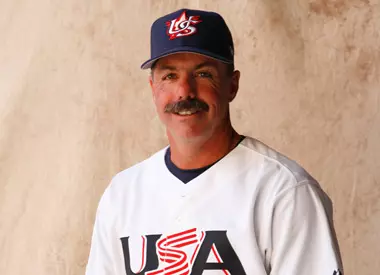
Dick Cooke, in his 18th season with the Wildcats, serves as an auxiliary coach with Team USA.
A Golden Opportunity
12/10/2007 11:20:16 AM | Baseball
Lauren Biggers -- Assistant SID
For the first time since 1974, the United States won the gold medal at the 2007 IBAF World Cup behind a 6-3 win over international powerhouse Cuba on Nov. 18 in Taipei City.
The Americans picked up their second straight win over the Cubans in international play, the last at a 2006 qualifying tournament in Havana for the 2008 Olympics. As an auxiliary coach with the United States professional national team, Davidson head baseball coach Dick Cooke was on the bench for both victories.
The lone college coach on the staff that includes manager Davey Johnson, pitching coach Marcel Lachermann, hitting coach Reggie Smith, third base coach Rick Eckstein and auxiliary coach Rolando de Armas, Cooke's tenure with the national team affords him an endless number of unique experiences, not the least of which will be the upcoming Olympics in Beijing.
Cooke, who enters his 18th season with the Wildcats, has served on the national team staff five times, dating back to the 1999 Pan Am Games, and along the way has learned plenty about the game, all the while seeing the world.
“Every time we do these trips, outside of the baseball part of it — which is a great piece of it, I've just about been around the globe now,” Cooke said. “Europe is about the only place I haven't been to that is of note baseball wise.”
This past trip carried Cooke and the national team to Tien Mou Stadium in Taipei City, Taiwan. After spending nine days in Arizona, where the 24-man roster first assembled and played in six games in MLB's Arizona Fall League (AFL), the team boarded a plane and set out to win the elusive gold medal.
The IBAF World Cup competition featured 16 teams, divided into two groups of eight, with the top four of each group advancing to the quarterfinals after seven days of round-robin play. The U.S. emerged as the No.1 seed from Group A, which also featured Chinese Taipei, Italy, Japan, Mexico, Panama, South Africa and Spain. Cuba did the same in Group B, which included Australia, Canada, Germany, Korea, Netherlands, Thailand and Venezuela.
“Cuba is the preeminent international team in the world,” Cooke said. “So any time you go into these events, you hope things unfold in a certain way, so that you are going to see Cuba at a certain point. You don't want to see them in the quarterfinals.”
After defeating Korea 3-1 in the quarterfinals, the U.S. blanked the Netherlands 5-0 in the semifinals and earned that gold-medal showdown with the Cubans, who had won nine straight World Cups. Brian Duensing (of the Minnesota Twins organization and with Triple-AAA Rochester in 2007) pitched the Americans to an early 4-0 lead, which proved enough for the 6-3 win for gold.
“As we always do, in Arizona we started talking about Cuba and who is going to pitch against them,” Cooke said. “We wanted to map the pitching out to get there. We jumped on them early, and that's the second time in a row that we have beaten Cuba in a final, so that's a big deal for us.”
Both the Cubans and the Americans send professional players to the international events, though the United States only recently started doing so for the World Cup, with both teams pulling players from the professional ranks. Unlike the Americans, though, the Cuban national team is a team in every sense of the word, with Cooke likening their seasoned players to 10-year veterans with a major league club. The U.S. on the other hand combines young, but promising minor league players onto a roster that is in constant flux because of major-league call-ups.
The team-building process for the national team is akin to draft day mixed with signing day. U.S.A. baseball scouts evaluate the on-field talent, while conversations with major league organizations and players' agents take place off the field on conference calls and in boardrooms. Even after the roster is seemingly established, last minute call-ups and trades can change things with a single phone call.
“We were getting ready to fly to Cuba in a day, and because of an injury to an outfielder, they said, 'We need to take one of our fielders up,” Cooke said. “So he left us, got on a plane, flew to Chicago and met the Phillies there. He was literally walking to the hotel with his bags, and the Phillies completed a trade for another guy. The next morning he flew back to us. So it's that type of stuff. It's the last hour.”
Cooke compares building the roster to recruiting, as the coaching staff aims to put a group of guys on the field that gel, and in this situation, quickly.
“We obviously have good players, so our job is not to coach them,” Cooke said. “It's to keep them in their routine. There are some guys they might make an adjustment with here or there, but it's basically like recruiting, in the sense that what you really want to do is bring good players to the table, so you're not having to coach them a whole lot.”
While there may be less coaching in the traditional sense of the word, especially as it relates to the college game, the coaches are an invaluable part of the team, and Cooke, a sponge soaking up years of baseball knowledge.
“These guys have been around professional baseball as players and managers forever,” Cooke said. “Davey Johnson had an unbelievable playing career, won almost 1200 games as a manager, won a world series. He started playing professional ball in the early 60s. So you sit around when you are with him for three weeks or a month, and it's basically a nonstop kind of informal baseball clinic.”
In addition to working alongside Johnson, Cooke has served on staffs managed by Tommy Lasorda, Frank Robinson and Buddy Bell. Traveling the world is fun, sure, but what he most takes away from his time with the national team is watching the managers interact with the players.
“There are certainly some things we talk about mechanically — what's Reggie Smith's hitting philosophy,” Cooke said “But ultimately, it's watching how we handle players. I don't think you really sit down and take notes as much you as you take note of it and then say, 'That was an interesting way to handle that situation and that player.'”
Universally acknowledged, baseball's grind is unlike that of any sport. Major league teams play 162 games; minor league teams, 140. On the college level, games stretch over five months. Learning how to handle that grind is often the key to a team's success, and with the national team, Cooke has watched some of the best in action.
“We go out and lose to Italy, which is an incredibly disappointing loss,” Cooke said. “The U.S.A. baseball guys were ready to jump off a building, and Davey was like, 'Well, we are gonna have to be a little better tomorrow.' There was no ranting and raving and screaming.”
Like all good coaching junkies, Cooke relishes scouting reports and dissecting another team's game plan. Scouting the Cuban national team with the likes of Jones, Lasorda or Robinson is perhaps as good as it gets.
“The guys I've been able to hang out with staff wise, their history is unbelievable,” Cooke said. “These guys are the highest of the high-ups of baseball, respect wise, and the years of experience, it's unbelievable. Our pitching coach, Marcel Lachermann, he's telling me stories 'Well, Don Drysdale told me this, and Sandy Koufax told me this.' These are some of the most prominent names in the history of the game.”
There's plenty of time for talking baseball to be sure, but after the first pitch, it's down to business for everybody.
“The great thing about all these guys is they are very inclusive,” Cooke said. “It's not, 'Okay you are the college guy.' Davey wants to know, 'What do you think about the lineup? Should we hit LaRoche third, fifth, what do you think?'”
Aside from winning the gold medal, the World Cup was yet another opportunity for the coaching staff to evaluate players. Next up for the national team is the Olympics, with that roster to be finalized by July 15.
Eight teams earn berths to Beijing, with the U.S., Cuba, the Netherlands and Japan already in. As the host country, China gets an automatic bid, and the top three teams from a qualifying team this spring will complete the field.
Having defeated Cuba in two straight finals, the U.S. team is surely feeling good about their chances, but the field will undoubtedly be a tough one. No matter the challenge, Cooke and the national team will continue to enjoy the ride.
“Every single player who goes to these things comes away going 'Wow, that was the most amazing thing I've ever done,'” Cooke said. “We had one player who said at the end of it, 'I was sick a lot of the trip, I hated the food, the hotel rooms were small; this was the greatest thing I've ever done.'”
The Americans picked up their second straight win over the Cubans in international play, the last at a 2006 qualifying tournament in Havana for the 2008 Olympics. As an auxiliary coach with the United States professional national team, Davidson head baseball coach Dick Cooke was on the bench for both victories.
The lone college coach on the staff that includes manager Davey Johnson, pitching coach Marcel Lachermann, hitting coach Reggie Smith, third base coach Rick Eckstein and auxiliary coach Rolando de Armas, Cooke's tenure with the national team affords him an endless number of unique experiences, not the least of which will be the upcoming Olympics in Beijing.
Cooke, who enters his 18th season with the Wildcats, has served on the national team staff five times, dating back to the 1999 Pan Am Games, and along the way has learned plenty about the game, all the while seeing the world.
“Every time we do these trips, outside of the baseball part of it — which is a great piece of it, I've just about been around the globe now,” Cooke said. “Europe is about the only place I haven't been to that is of note baseball wise.”
This past trip carried Cooke and the national team to Tien Mou Stadium in Taipei City, Taiwan. After spending nine days in Arizona, where the 24-man roster first assembled and played in six games in MLB's Arizona Fall League (AFL), the team boarded a plane and set out to win the elusive gold medal.
The IBAF World Cup competition featured 16 teams, divided into two groups of eight, with the top four of each group advancing to the quarterfinals after seven days of round-robin play. The U.S. emerged as the No.1 seed from Group A, which also featured Chinese Taipei, Italy, Japan, Mexico, Panama, South Africa and Spain. Cuba did the same in Group B, which included Australia, Canada, Germany, Korea, Netherlands, Thailand and Venezuela.
“Cuba is the preeminent international team in the world,” Cooke said. “So any time you go into these events, you hope things unfold in a certain way, so that you are going to see Cuba at a certain point. You don't want to see them in the quarterfinals.”
After defeating Korea 3-1 in the quarterfinals, the U.S. blanked the Netherlands 5-0 in the semifinals and earned that gold-medal showdown with the Cubans, who had won nine straight World Cups. Brian Duensing (of the Minnesota Twins organization and with Triple-AAA Rochester in 2007) pitched the Americans to an early 4-0 lead, which proved enough for the 6-3 win for gold.
“As we always do, in Arizona we started talking about Cuba and who is going to pitch against them,” Cooke said. “We wanted to map the pitching out to get there. We jumped on them early, and that's the second time in a row that we have beaten Cuba in a final, so that's a big deal for us.”
Both the Cubans and the Americans send professional players to the international events, though the United States only recently started doing so for the World Cup, with both teams pulling players from the professional ranks. Unlike the Americans, though, the Cuban national team is a team in every sense of the word, with Cooke likening their seasoned players to 10-year veterans with a major league club. The U.S. on the other hand combines young, but promising minor league players onto a roster that is in constant flux because of major-league call-ups.
The team-building process for the national team is akin to draft day mixed with signing day. U.S.A. baseball scouts evaluate the on-field talent, while conversations with major league organizations and players' agents take place off the field on conference calls and in boardrooms. Even after the roster is seemingly established, last minute call-ups and trades can change things with a single phone call.
“We were getting ready to fly to Cuba in a day, and because of an injury to an outfielder, they said, 'We need to take one of our fielders up,” Cooke said. “So he left us, got on a plane, flew to Chicago and met the Phillies there. He was literally walking to the hotel with his bags, and the Phillies completed a trade for another guy. The next morning he flew back to us. So it's that type of stuff. It's the last hour.”
Cooke compares building the roster to recruiting, as the coaching staff aims to put a group of guys on the field that gel, and in this situation, quickly.
“We obviously have good players, so our job is not to coach them,” Cooke said. “It's to keep them in their routine. There are some guys they might make an adjustment with here or there, but it's basically like recruiting, in the sense that what you really want to do is bring good players to the table, so you're not having to coach them a whole lot.”
While there may be less coaching in the traditional sense of the word, especially as it relates to the college game, the coaches are an invaluable part of the team, and Cooke, a sponge soaking up years of baseball knowledge.
“These guys have been around professional baseball as players and managers forever,” Cooke said. “Davey Johnson had an unbelievable playing career, won almost 1200 games as a manager, won a world series. He started playing professional ball in the early 60s. So you sit around when you are with him for three weeks or a month, and it's basically a nonstop kind of informal baseball clinic.”
In addition to working alongside Johnson, Cooke has served on staffs managed by Tommy Lasorda, Frank Robinson and Buddy Bell. Traveling the world is fun, sure, but what he most takes away from his time with the national team is watching the managers interact with the players.
“There are certainly some things we talk about mechanically — what's Reggie Smith's hitting philosophy,” Cooke said “But ultimately, it's watching how we handle players. I don't think you really sit down and take notes as much you as you take note of it and then say, 'That was an interesting way to handle that situation and that player.'”
Universally acknowledged, baseball's grind is unlike that of any sport. Major league teams play 162 games; minor league teams, 140. On the college level, games stretch over five months. Learning how to handle that grind is often the key to a team's success, and with the national team, Cooke has watched some of the best in action.
“We go out and lose to Italy, which is an incredibly disappointing loss,” Cooke said. “The U.S.A. baseball guys were ready to jump off a building, and Davey was like, 'Well, we are gonna have to be a little better tomorrow.' There was no ranting and raving and screaming.”
Like all good coaching junkies, Cooke relishes scouting reports and dissecting another team's game plan. Scouting the Cuban national team with the likes of Jones, Lasorda or Robinson is perhaps as good as it gets.
“The guys I've been able to hang out with staff wise, their history is unbelievable,” Cooke said. “These guys are the highest of the high-ups of baseball, respect wise, and the years of experience, it's unbelievable. Our pitching coach, Marcel Lachermann, he's telling me stories 'Well, Don Drysdale told me this, and Sandy Koufax told me this.' These are some of the most prominent names in the history of the game.”
There's plenty of time for talking baseball to be sure, but after the first pitch, it's down to business for everybody.
“The great thing about all these guys is they are very inclusive,” Cooke said. “It's not, 'Okay you are the college guy.' Davey wants to know, 'What do you think about the lineup? Should we hit LaRoche third, fifth, what do you think?'”
Aside from winning the gold medal, the World Cup was yet another opportunity for the coaching staff to evaluate players. Next up for the national team is the Olympics, with that roster to be finalized by July 15.
Eight teams earn berths to Beijing, with the U.S., Cuba, the Netherlands and Japan already in. As the host country, China gets an automatic bid, and the top three teams from a qualifying team this spring will complete the field.
Having defeated Cuba in two straight finals, the U.S. team is surely feeling good about their chances, but the field will undoubtedly be a tough one. No matter the challenge, Cooke and the national team will continue to enjoy the ride.
“Every single player who goes to these things comes away going 'Wow, that was the most amazing thing I've ever done,'” Cooke said. “We had one player who said at the end of it, 'I was sick a lot of the trip, I hated the food, the hotel rooms were small; this was the greatest thing I've ever done.'”


2025-26 Swimming & Diving - Dylan Felt (NCAA Qualifier)
Wednesday, March 25
2026 Davidson Football Spring Zoom Call
Thursday, March 19
2025-26 Wrestling - Anderson Heap (NCAA Qualifier)
Monday, March 16
2025-26 Men's Basketball - Brock Matheny (Senior Spotlight)
Sunday, March 15