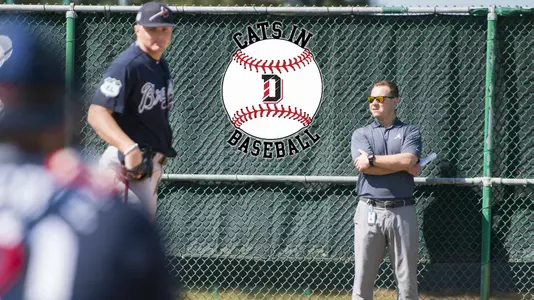
'Cats in Baseball: Billy Ryan
8/12/2020 9:07:00 PM | Baseball
Cats in Baseball is a series of stories highlighting Davidson alumni who work in the highest levels of the game. The series opener is here.
Billy Ryan '02
• Catcher
• Degree: Psychology
• Professional Scout, Atlanta Braves
Billy Ryan has been evaluating big league baseball talent for years now, has watched young potential turn into pro production, most notably for clubs in Arizona and Atlanta.
But what does the Braves pro scout now see when he looks back on a certain Davidson catcher, who wore No. 28 and played from 1998 to 2002?
Well, he sees a guy who led the Wildcats with a .342 average in 2001 and earned Second Team All-Southern Conference honors. And he sees a reliable catcher, who split time with James Marino, and often filled the DH role, especially after suffering a shoulder injury playing summer ball prior to his senior year.
"But I can probably sum this up in one story," he says.
Ryan remembers sitting in the dugout between games of a Davidson doubleheader, eating a quick meal and talking with then-sports information director Rick Bender. Bender asked if he knew that he hadn't struck out in more than 100 consecutive at-bats.
"I was like, 'Really? That's pretty cool,'" says Ryan. "Then he says, 'Well, you've also gone that long without a walk.' That didn't sound as good. … I was just up there swinging. For a guy who was hitting in the middle of the lineup, I'm not sure that was the best approach."
Recruited out of the Boston area by then-assistant and current Columbia head coach Brett Boretti, Ryan says he was probably the anti-Moneyball player before Moneyball. He always hit for a high average (.324 career) and ironically went 52-for-152 his junior year and 42-for-142 as a senior. He also proved to be solid behind the plate for coach Dick Cooke, bringing "an old-fashioned, in a good way" kind of hard-working approach to the field.
"We were lucky to have two good catchers, with he and Marino," says Cooke. "Billy did a great job filling the defensive role we needed, but also became a great force at the plate."
After graduation, Ryan worked outside of sports for a little more than a year before getting into the game as a baseball operations intern with the Texas Rangers.
"I had to kind of figure out what came next, and baseball had always been such a big part of my life," he says. "It was hard to imagine doing anything else, quite honestly."
Still, he knew there were no guarantees in such a competitive industry, where there are people in line behind you with the same aspirations.
But he's served as Cleveland's area scouting supervisor, Atlanta's director of baseball operations, and as an assistant general manager in Arizona, he looked on as now six-time All-Star first baseman Paul Goldschmidt signed an extension.
Breaks of the game
One of Ryan's breaks came when he wasn't necessarily looking for one.
He was scouting for Cleveland and based, ironically, in Atlanta. He was patrolling South Carolina, Georgia and northern Florida for the next crop of talent when opportunity knocked. Actually, it rang his cell phone late one night when he was driving on a rural road, eating a chicken sandwich and rushing back to his hotel after watching a potential prospect.
The job was a newly created one: senior coordinator in the Major League Baseball Labor Relations Department.
"I was really conflicted on it because I loved the scouting piece of it, I loved what I was doing, I was working with good people, but it just came down to it's too good of an opportunity to pass up," says Ryan. "So I went from the backwoods of South Carolina to Park Avenue in the span of about a month, wearing a shirt and tie to work every day. It was an adjustment for sure, but a great professional development opportunity for me. I learned a ton, obviously more on the business side of the game than the operations/talent side of it, but it really did wonders for me in preparing me for the next steps in my career."
In the commissioner's office, Ryan often dealt with compliance issues, serving both as an enforcer of rules and a consultant for teams conducting day-to-day business. He worked in global economics and with competitive balance.
"It was a unique perspective," he says. "You get to see how 30 teams operate, what you like, what you don't like, people that you may see yourself aligning with more than others."
Behind the plate, behind the scenes
It's been 18 years since Ryan caught his final game, but he believes being a catcher — and seeing the game through that lens — has helped him ever since.
He enjoys working behind the scenes, scouting pro players for potential acquisition through trades — Cooke has joined him at some Charlotte Knights games — and assignments like advance scouting for the Braves' potential playoff opponents. Last year, that meant taking a deep dive on the St. Louis Cardinals, featuring his old pal Goldschmidt and a call-up named Tommy Edman, the older brother of former Davidson volleyball player Elise Edman.
"With that," says Ryan, "it's always, 'Who's the guy you don't want to beat you?' Well, it's still got to be Goldschmidt, but don't forget about this Edman guy. He's playing out of his mind right now."
Braves Gold Glove outfielder Ender Inciarte stands out among the players Ryan has seen climb the ladder. Inciarte came up in the Arizona system when Ryan was with the Diamondbacks, then became a major leaguer Ryan and the Braves traded for in 2015.
"I was able to be in a place where he developed, and then to be with an organization that acquired him as a legit major league player, it's unique," says Ryan.
That's the kind of story that makes the long hours, the pressure and the sacrifices all worth it.
"That's probably the most gratifying part, being a part of that collective team that helps players develop," he says. "Ultimately, the players are the ones that are going to do it themselves and obviously deserve the lion's share of the credit, but to be along that journey and help in some small way is gratifying."
Billy Ryan '02
• Catcher
• Degree: Psychology
• Professional Scout, Atlanta Braves
Billy Ryan has been evaluating big league baseball talent for years now, has watched young potential turn into pro production, most notably for clubs in Arizona and Atlanta.
But what does the Braves pro scout now see when he looks back on a certain Davidson catcher, who wore No. 28 and played from 1998 to 2002?
Well, he sees a guy who led the Wildcats with a .342 average in 2001 and earned Second Team All-Southern Conference honors. And he sees a reliable catcher, who split time with James Marino, and often filled the DH role, especially after suffering a shoulder injury playing summer ball prior to his senior year.
"But I can probably sum this up in one story," he says.
Ryan remembers sitting in the dugout between games of a Davidson doubleheader, eating a quick meal and talking with then-sports information director Rick Bender. Bender asked if he knew that he hadn't struck out in more than 100 consecutive at-bats.
"I was like, 'Really? That's pretty cool,'" says Ryan. "Then he says, 'Well, you've also gone that long without a walk.' That didn't sound as good. … I was just up there swinging. For a guy who was hitting in the middle of the lineup, I'm not sure that was the best approach."
Recruited out of the Boston area by then-assistant and current Columbia head coach Brett Boretti, Ryan says he was probably the anti-Moneyball player before Moneyball. He always hit for a high average (.324 career) and ironically went 52-for-152 his junior year and 42-for-142 as a senior. He also proved to be solid behind the plate for coach Dick Cooke, bringing "an old-fashioned, in a good way" kind of hard-working approach to the field.
"We were lucky to have two good catchers, with he and Marino," says Cooke. "Billy did a great job filling the defensive role we needed, but also became a great force at the plate."
After graduation, Ryan worked outside of sports for a little more than a year before getting into the game as a baseball operations intern with the Texas Rangers.
"I had to kind of figure out what came next, and baseball had always been such a big part of my life," he says. "It was hard to imagine doing anything else, quite honestly."
Still, he knew there were no guarantees in such a competitive industry, where there are people in line behind you with the same aspirations.
But he's served as Cleveland's area scouting supervisor, Atlanta's director of baseball operations, and as an assistant general manager in Arizona, he looked on as now six-time All-Star first baseman Paul Goldschmidt signed an extension.
Breaks of the game
One of Ryan's breaks came when he wasn't necessarily looking for one.
He was scouting for Cleveland and based, ironically, in Atlanta. He was patrolling South Carolina, Georgia and northern Florida for the next crop of talent when opportunity knocked. Actually, it rang his cell phone late one night when he was driving on a rural road, eating a chicken sandwich and rushing back to his hotel after watching a potential prospect.
The job was a newly created one: senior coordinator in the Major League Baseball Labor Relations Department.
"I was really conflicted on it because I loved the scouting piece of it, I loved what I was doing, I was working with good people, but it just came down to it's too good of an opportunity to pass up," says Ryan. "So I went from the backwoods of South Carolina to Park Avenue in the span of about a month, wearing a shirt and tie to work every day. It was an adjustment for sure, but a great professional development opportunity for me. I learned a ton, obviously more on the business side of the game than the operations/talent side of it, but it really did wonders for me in preparing me for the next steps in my career."
In the commissioner's office, Ryan often dealt with compliance issues, serving both as an enforcer of rules and a consultant for teams conducting day-to-day business. He worked in global economics and with competitive balance.
"It was a unique perspective," he says. "You get to see how 30 teams operate, what you like, what you don't like, people that you may see yourself aligning with more than others."
Behind the plate, behind the scenes
It's been 18 years since Ryan caught his final game, but he believes being a catcher — and seeing the game through that lens — has helped him ever since.
He enjoys working behind the scenes, scouting pro players for potential acquisition through trades — Cooke has joined him at some Charlotte Knights games — and assignments like advance scouting for the Braves' potential playoff opponents. Last year, that meant taking a deep dive on the St. Louis Cardinals, featuring his old pal Goldschmidt and a call-up named Tommy Edman, the older brother of former Davidson volleyball player Elise Edman.
"With that," says Ryan, "it's always, 'Who's the guy you don't want to beat you?' Well, it's still got to be Goldschmidt, but don't forget about this Edman guy. He's playing out of his mind right now."
Braves Gold Glove outfielder Ender Inciarte stands out among the players Ryan has seen climb the ladder. Inciarte came up in the Arizona system when Ryan was with the Diamondbacks, then became a major leaguer Ryan and the Braves traded for in 2015.
"I was able to be in a place where he developed, and then to be with an organization that acquired him as a legit major league player, it's unique," says Ryan.
That's the kind of story that makes the long hours, the pressure and the sacrifices all worth it.
"That's probably the most gratifying part, being a part of that collective team that helps players develop," he says. "Ultimately, the players are the ones that are going to do it themselves and obviously deserve the lion's share of the credit, but to be along that journey and help in some small way is gratifying."

2026 Davidson Baseball Preseason Virtual Event
Friday, January 30
FY26 Baseball Fall Virtual Event (11-06-25)
Wednesday, November 12
Coach Cooke Retirement Video
Wednesday, October 29
2024 Davidson Baseball Alumni Game Will DuBose message
Wednesday, August 14