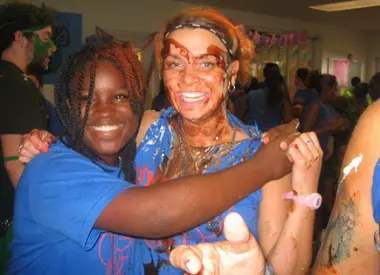
Stallings taught Earth Science to rising seventh and eighth graders with Breakthrough.
What I Did over Summer Break...
9/11/2007 1:25:42 PM | General
Lauren Biggers
For most college students, summer break is pretty much what it sounds like - a break from academics and books, from dorm rooms and cafeteria food, and for student-athletes, from coaches and practices. But for senior field hockey midfielder Misty Stallings and sophomore men's soccer forward Clint Smith, summer was anything but a break.
Stallings spent her summer in Ft. Lauderdale, Fla., teaching earth science to rising seventh and eighth graders through Breakthrough Collaborative, "a national non-profit that increases educational opportunities for high-potential, low-income middle school students and inspires outstanding college and high school students to pursue careers in education" (www.breakthroughcollaborative.org).

For eight hours a day, five days a week, Stallings brought the school's curriculum to life, through activities like constructing volcanoes and making ice cream, doing anything and everything to help her “motivated, underserved students” learn to learn. With the hope of opening their eyes to higher education, Stallings and her “family” of students, adopted the University of Florida Gators as their “home school,” gaining perspective on what could be. For her tenure, she lived with a local family and more than once shared the students' hour-long bus ride to experience their world more completely.
Meanwhile Smith, the recipient of a $1,000 grant from the college's DuPont Summer Experience, spent his summer in his hometown New Orleans teaching African-American kids aged 6-13 the fundamentals of soccer and serving as senior director and ambassador of soccer to urban communities for the New Orleans Recreation Department (NORD).
In different parts of the country, Smith and Stallings were teaching different subjects to different children, and yet, their experiences proved unexpectedly similar.
Working with NORD, Smith set out to challenge common misperceptions of soccer.
“Unfortunately in our society, soccer is seen as a suburban white sport,” Smith wrote in his grant proposal. “Thus many black children are discouraged from playing the sport because they feel as though they are risking their blackness.”
Calling the idea “completely ridiculous,” he designed his soccer clinics to challenge this notion and offered himself as evidence.
 “As an African-American male playing soccer at the collegiate level, I felt as if I had a responsibility to clear as many people as I could of this misconception,” Smith said. “Thus, the original goal of this endeavor was ultimately to raise awareness of the sport within the black community and instill within them a newfound interest in what the world of soccer has to offer.”
Likewise, Stallings sought to change perceptions, albeit in a slightly different way. Working with children of “low, social-economic status” at one of Breakthrough's 30 national and international sites, Stallings hoped to expose the underprivileged to the possibility of higher education.
“The kids at Breakthrough all applied and are very smart,” Stallings said. “They know they are going to be getting at least three hours of homework over summer break every night. Our goal is to get 100% to graduate from college. My kids graduate in 2016, so that was the year we kept talking about. And around 80 percent will be the first in their families to go to college, which is a really huge deal.”
With clear goals set before them, Smith and Stallings went to work, but perhaps as expected, learned more than they taught and received more than they gave.
“My time with the kids has done so much more than (teach them about soccer),” Smith said. “Through these sessions, the children have learned the importance of teamwork, camaraderie, and hard work, all attributes they are able to bring back and use in their daily lives. Additionally, they have learned how soccer builds cultural bridges throughout the world on a daily basis.
“Apart from the relationships I developed with the kids, one particular moment that really touched me was when one of the kids came to me and said that he went home after one session and showed the kids in his neighborhood some of the tricks and things that he learned that day,” he continued. “He said they all put their basketballs on the ground and started trying to do soccer tricks with them. That really hit home for me because that was the primary objective of the whole endeavor — to get more inner-city kids interested in a sport in which they could really excel.”
And while Stallings learned that “getting kids interested in rocks” is harder than it looks, she also saw that appearances can be deceiving.
 “My kids taught me so much,” she said. “They were going through things that seemed so advanced and so mature. They are adults in so many ways, but then you open up their cd case, and they have Cheetah Girls and their favorite show is Sponge Bob. Some of these kids even ran their households. It was very humbling. Any aspect where I thought I could relate, it was a much lesser degree than I had anticipated.”
Soccer undoubtedly played a central role in Smith's summer, but he too found life lessons that transcend sport.
“What has perhaps been even more rewarding than the soccer has been the dialogue I have created between myself and many of the children, dialogue that is not even related to soccer,” Smith said. “Many of these kids grow up in single-parent households, attend schools with 40 kids in a classroom, and do not have any sort of older male figure in their lives.
“Many of them just want someone to talk to,” he continued. “So when a college student sits down with them and takes a genuine interest in what they have to say, their eyes light up, and they share with you their entire world. Our conversations ranged from how their parents' divorce has affected them, to how all the different flavors get put inside of jelly beans.”
As other college students spent their summers idly passing time, Smith and Stallings chose to do something different, and in the process, discovered new passions.
“When the opportunity arose to combine my passion for soccer, my love for kids, as well as the chance to remain in the city of New Orleans in continued effort to help rebuild after Hurricane Katrina, it was a prospect I could not pass up,” Smith said. “The sessions have been so successful that there have already been discussions of conducting Christmas camps during my winter break. There is even the possibility of setting up a year-round league that would be free of charge for anyone who wants to participate.
“I get goose bumps when I think of all the possibilities that exist,” he continued. “And I cannot wait to see how far we take this project.”
Stallings, who was offered a job upon graduation if she so chooses, found her experience even more fulfilling than expected.
“It was like summer camp in the sense that it was high-intensity,” she said. “I was hoarse all summer, but there was also so much learning that happened. We would have guest speakers, and I have never been so proud of something — not just what I was doing — but of my kids. I still talk to my kids on email, or they call me like every other day. It's definitely something I am going to do again next summer.”
Stallings spent her summer in Ft. Lauderdale, Fla., teaching earth science to rising seventh and eighth graders through Breakthrough Collaborative, "a national non-profit that increases educational opportunities for high-potential, low-income middle school students and inspires outstanding college and high school students to pursue careers in education" (www.breakthroughcollaborative.org).
For eight hours a day, five days a week, Stallings brought the school's curriculum to life, through activities like constructing volcanoes and making ice cream, doing anything and everything to help her “motivated, underserved students” learn to learn. With the hope of opening their eyes to higher education, Stallings and her “family” of students, adopted the University of Florida Gators as their “home school,” gaining perspective on what could be. For her tenure, she lived with a local family and more than once shared the students' hour-long bus ride to experience their world more completely.
Meanwhile Smith, the recipient of a $1,000 grant from the college's DuPont Summer Experience, spent his summer in his hometown New Orleans teaching African-American kids aged 6-13 the fundamentals of soccer and serving as senior director and ambassador of soccer to urban communities for the New Orleans Recreation Department (NORD).
In different parts of the country, Smith and Stallings were teaching different subjects to different children, and yet, their experiences proved unexpectedly similar.
Working with NORD, Smith set out to challenge common misperceptions of soccer.
“Unfortunately in our society, soccer is seen as a suburban white sport,” Smith wrote in his grant proposal. “Thus many black children are discouraged from playing the sport because they feel as though they are risking their blackness.”
Calling the idea “completely ridiculous,” he designed his soccer clinics to challenge this notion and offered himself as evidence.
“As an African-American male playing soccer at the collegiate level, I felt as if I had a responsibility to clear as many people as I could of this misconception,” Smith said. “Thus, the original goal of this endeavor was ultimately to raise awareness of the sport within the black community and instill within them a newfound interest in what the world of soccer has to offer.”Likewise, Stallings sought to change perceptions, albeit in a slightly different way. Working with children of “low, social-economic status” at one of Breakthrough's 30 national and international sites, Stallings hoped to expose the underprivileged to the possibility of higher education.
“The kids at Breakthrough all applied and are very smart,” Stallings said. “They know they are going to be getting at least three hours of homework over summer break every night. Our goal is to get 100% to graduate from college. My kids graduate in 2016, so that was the year we kept talking about. And around 80 percent will be the first in their families to go to college, which is a really huge deal.”
With clear goals set before them, Smith and Stallings went to work, but perhaps as expected, learned more than they taught and received more than they gave.
“My time with the kids has done so much more than (teach them about soccer),” Smith said. “Through these sessions, the children have learned the importance of teamwork, camaraderie, and hard work, all attributes they are able to bring back and use in their daily lives. Additionally, they have learned how soccer builds cultural bridges throughout the world on a daily basis.
“Apart from the relationships I developed with the kids, one particular moment that really touched me was when one of the kids came to me and said that he went home after one session and showed the kids in his neighborhood some of the tricks and things that he learned that day,” he continued. “He said they all put their basketballs on the ground and started trying to do soccer tricks with them. That really hit home for me because that was the primary objective of the whole endeavor — to get more inner-city kids interested in a sport in which they could really excel.”
And while Stallings learned that “getting kids interested in rocks” is harder than it looks, she also saw that appearances can be deceiving.
“My kids taught me so much,” she said. “They were going through things that seemed so advanced and so mature. They are adults in so many ways, but then you open up their cd case, and they have Cheetah Girls and their favorite show is Sponge Bob. Some of these kids even ran their households. It was very humbling. Any aspect where I thought I could relate, it was a much lesser degree than I had anticipated.”Soccer undoubtedly played a central role in Smith's summer, but he too found life lessons that transcend sport.
“What has perhaps been even more rewarding than the soccer has been the dialogue I have created between myself and many of the children, dialogue that is not even related to soccer,” Smith said. “Many of these kids grow up in single-parent households, attend schools with 40 kids in a classroom, and do not have any sort of older male figure in their lives.
“Many of them just want someone to talk to,” he continued. “So when a college student sits down with them and takes a genuine interest in what they have to say, their eyes light up, and they share with you their entire world. Our conversations ranged from how their parents' divorce has affected them, to how all the different flavors get put inside of jelly beans.”
As other college students spent their summers idly passing time, Smith and Stallings chose to do something different, and in the process, discovered new passions.
“When the opportunity arose to combine my passion for soccer, my love for kids, as well as the chance to remain in the city of New Orleans in continued effort to help rebuild after Hurricane Katrina, it was a prospect I could not pass up,” Smith said. “The sessions have been so successful that there have already been discussions of conducting Christmas camps during my winter break. There is even the possibility of setting up a year-round league that would be free of charge for anyone who wants to participate.
“I get goose bumps when I think of all the possibilities that exist,” he continued. “And I cannot wait to see how far we take this project.”
Stallings, who was offered a job upon graduation if she so chooses, found her experience even more fulfilling than expected.
“It was like summer camp in the sense that it was high-intensity,” she said. “I was hoarse all summer, but there was also so much learning that happened. We would have guest speakers, and I have never been so proud of something — not just what I was doing — but of my kids. I still talk to my kids on email, or they call me like every other day. It's definitely something I am going to do again next summer.”
2025-26 Swimming & Diving - Dylan Felt (NCAA Qualifier)
Wednesday, March 25
2026 Davidson Football Spring Zoom Call
Thursday, March 19
2025-26 Wrestling - Anderson Heap (NCAA Qualifier)
Monday, March 16
2025-26 Men's Basketball - Brock Matheny (Senior Spotlight)
Sunday, March 15